















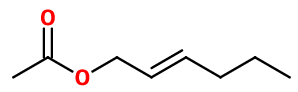
Photo credits: ScenTree SAS
Trans-2-hexenyl acetate
Fruity > Green Fruits > Metallic
(E)-2-Hexenyl acetate ; Aceto trans-2-Esenil ; Trans-2-Hexen-1-yl acetate ; (E)-2-hexen-1-ol acetate


Photo credits: ScenTree SAS
| Company | Ingredient Name | Learn more | Naturality | Certifications | MOQ | Purity |
|---|---|---|---|---|---|---|

|
TRANS 2 HEXENYL ACETATE
T2HA-1
|
Discover | - | 10 grs | 97.0 - 100.0 | |

|
Trans-2-Hexenyl Acetate | Discover | Synthetic Aroma Chemicals | - | - | |
|
|
Trans-2-Hexenyl Acetate natural | Discover | Natural Aroma Chemicals | - | - |
T2HA-1


General Presentation
-
CAS N° :
2497-18-9 -
EINECS number :
219-680-7 -
FEMA number :
2564 -
FLAVIS number :
9,394
-
JECFA number :
1355 -
Volatility :
Head/Heart -
Price Range :
€€€
Physico-chemical properties
-
Appearance :
Colorless liquid -
Density :
0,897 -
Refractive Index @20°C :
Donnée indisponible. -
Optical rotation :
Donnée indisponible. -
Vapor pressure :
Donnée indisponible. -
Flash Point :
59°C (138,2°F)
-
Molecular formula :
C8H14O2 -
Molecular Weight :
142,2 g/mol -
Log P :
Donnée indisponible. -
Fusion Point :
Donnée indisponible. -
Boiling Point :
166°C (330,8°F) -
Detection Threshold :
Donnée indisponible.
Chemistry & Uses
Uses in perfumery :
Trans-2-Hexenyl acetate is mainly used in fruity and green apple or pear notes, among others, to combine a juicy effect and make the link between a fruity and a green facet.
Year of discovery :
Data not available.
Natural availability :
Trans-2-Hexenyl acetate is found in the fragrant principle of certain fruits such as apple, banana or mango, but also in trace amounts in some essential oils such as Peppermint EO. It is therefore its synthetic version that is most used in perfumery.
Isomerism :
Trans-2-hexenyl acetate is a diastereoisomer of cis-2-Hexenyl acetate, much less used in perfumery. On the other hand, cis-3-Hexenyl acetate, the position isomer of trans-2-Hexenyl acetate, has a much greener smell, reminiscent of cut grass, and with substantially equivalent fruity accents.
Synthesis precursor :
Trans-2-Hexenyl acetate is not a precursor to the synthesis of another compound of olfactory interest.
Synthesis route :
Trans-2-Hexenyl acetate can be synthesized by an esterification reaction, by reacting trans-2-Hexenol with acetic acid, in the presence of an acid catalyst such as concentrated sulfuric acid, in very small quantity in the reaction medium. The efficiency of this reaction can be improved by using acetic anhydride or chloroacetic acid instead of acetic acid.
Stability :
acetates may form acetic acid through time.
Other comments :
Trans-2-Hexenyl acetate keeps the olfactory facets of the alcohol being at its origin: trans-2-Hexenol. Both have a fruity and green apple smell. Nevertheless, the esterification of the alcohol brings a juicier and syrupy note, making the ester suitable to bring such an effect in a composition.
Labelling
Allergens :
This ingredient does not contain any allergen.
Signal word :
Warning
Hazard pictograms :

Precautionary statements :
| HAZARD | PRECAUTION |
|---|---|
| H226 Flammable liquid and vapour. | P210 Keep away from heat, hot surfaces, sparks, open flames and other ignition sources. No smoking. P233 Keep container tightly closed. P240 Ground and bond container and receiving equipment. P242 Use non-sparking tools. P243 Take action to prevent static discharges. P280 Wear protective gloves/protective clothing/eye protection/face protection. P303 + P361 + P353 IF ON SKIN (or hair): Take off immediately all contaminated clothing. Rinse skin with water [or shower]. P403 + P235 Store in a well-ventilated place. Keep cool. P501 Dispose of contents/container to… |
IFRA
IFRA 51th :
This ingredient is not restricted for the 51th amendment