













Photo credits: ScenTree SAS
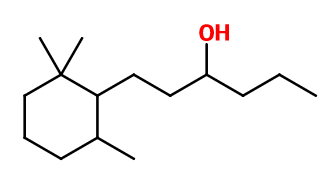
Timberol®
Woody > Ambery Woods > Ambergris > Dry Woods > Green
Norlimbanol® ; Karmawood® ; 1-(2,2,6-trimethylcyclohexyl)hexan-3-ol ; Dextramber ; Fine timber ; Nimberlan ; Nimberol ; Nirlimberol ; Timber forte ; Timber propanol ; Timber touch ; Timberone ; Trimethyl propyl cyclohexane propanol ; Woodamber


Photo credits: ScenTree SAS
| Company | Ingredient Name | Learn more | Naturality | Certifications | MOQ | Purity |
|---|---|---|---|---|---|---|
|
TIMBER SOFT
TIM-1
|
Discover | - | 10 grs | - | |
|
|
LIMBEROL
NIM-1
|
Discover | - | 10 grs | - | |
|
NORLIMBANOL®
967412
|
Discover | Molecules |

|
- | - |
|
|
NORLIMBANOL® DEXTRO
967406
|
Discover | Molecules |

|
- | - |
TIM-1

NIM-1
967412
967406

General Presentation
-
CAS N° :
70788-30-6 -
EINECS number :
274-892-7 -
FEMA number :
Donnée indisponible. -
FLAVIS number :
Donnée indisponible.
-
JECFA number :
Donnée indisponible. -
Volatility :
Base -
Price Range :
€€
Physico-chemical properties
-
Appearance :
Colorless liquid -
Density :
0,9 -
Refractive Index @20°C :
Donnée indisponible. -
Optical rotation :
Donnée indisponible. -
Vapor pressure :
0,00051 mmHg @25°C -
Flash Point :
122°C (251,6°F)
-
Molecular formula :
C15H30O -
Molecular Weight :
226,4 g/mol -
Log P :
5,9 -
Fusion Point :
Donnée indisponible. -
Boiling Point :
-
Detection Threshold :
5,8 ng/l air
Chemistry & Uses
Uses in perfumery :
Timberol® is used in masculine, woody, ambery, leather, fougere and citrus notes. Often used in detergents and other alkaline bases because it is very stable.
Year of discovery :
Discovered in 1978.
Natural availability :
Timberol® is not available in its natural state.
Isomerism :
Timberol® does not have any isomer used in perfumery.
Synthesis precursor :
Timberol® is not a precursor to the synthesis of another compound of olfactory interest.
Synthesis route :
The synthesis of Timberol® consists of several stages. The first is an aldolization reaction between Citral and 2-pentanone (in the presence of a basic substance), followed by a cyclization of the aldol obtained by a phosphoric acid, and then a hydrogenation of the compound obtained with a Raney nickel catalysis.
Stability :
Stable in perfumes and diverse functional bases
Other comments :
In comparision to other ambergris and woody notes as Ambermax 50® and Boisambrene Forte®, Timberol® has a distinctive green note.
Labelling
Allergens :
This ingredient does not contain any allergen.
Signal word :
Warning
Hazard pictograms :

Precautionary statements :
| HAZARD | PRECAUTION |
|---|---|
| H315 Causes skin irritation. | P264 Wash ... thoroughly after handling. P280 Wear protective gloves/protective clothing/eye protection/face protection. P302 + P352 IF ON SKIN: Wash with plenty of water/… P332 + P313 If skin irritation occurs: Get medical advice/attention. P362 Take off contaminated clothing. |
IFRA
IFRA 51th :
This ingredient is restricted by the 51th amendment
-
Restriction type :
RESTRICTION -
Cause of restriction :
DERMAL SENSITIZATION AND SYSTEMIC TOXICITY -
Amendment :
51
Quantitative limit on the use :
| Cat.1 | Cat.2 | Cat.3 | Cat.4 |
Cat.5
A
B
C
D
|
Cat.6 | |||
|---|---|---|---|---|---|---|---|---|
| 0,17 % | 0,071 % | 0,51 % | 1,3 % |
0,34 %
0,34 %
0,34 %
0,11 %
|
||||
|
Cat.5
A
B
C
D
|
Cat.6 | |||||||
|
0,34 %
0,34 %
0,34 %
0,11 %
|
0,17 % | |||||||
|
Cat.7
A
B
|
Cat.8 | Cat.9 |
Cat.10
A
B
|
Cat.11
A
B
|
Cat.12 | |||
|
0,51 %
0,51 %
|
0,11 % | 2,6 % |
0,68 %
4,7 %
|
0,11 %
0,11 %
|
||||
|
Cat.10
A
B
|
Cat.11
A
B
|
Cat.12 | ||||||
|
0,68 %
4,7 %
|
0,11 %
0,11 %
|
No restriction | ||||||
Disclaimer :
ScenTree is solely responsible for the information provided here.
To learn more about IFRA's standards : https://ifrafragrance.org/safe-use/library