
















Photo credits: ScenTree SAS
Peonile®
Floral > Rosy > Geranium > Spicy > Grapefruit
2-cyclohexyl-2-cyclohexylideneacetonitrile ; 2-cyclohexylidene-2-phenylacetonitrile ; 2-cyclohexyl-2-cyclohexylidene acetonitrile ; 2-cyclohexylidene-2-phenyl acetonitrile ; Geranium nitrile ; Gerolil ; Peolan


Photo credits: ScenTree SAS


General Presentation
-
CAS N° :
10461-98-0 -
EINECS number :
423-740-1 -
FEMA number :
Donnée indisponible. -
FLAVIS number :
Donnée indisponible.
-
JECFA number :
Donnée indisponible. -
Volatility :
Base -
Price Range :
€€€
Physico-chemical properties
-
Appearance :
Colorless liquid -
Density :
1,03 -
Refractive Index @20°C :
Donnée indisponible. -
Optical rotation :
Donnée indisponible. -
Vapor pressure :
Donnée indisponible. -
Flash Point :
> 93°C (> 199,4°F)
-
Molecular formula :
C14H15N -
Molecular Weight :
197,28 g/mol -
Log P :
4 -
Fusion Point :
27°C (80,6°F) -
Boiling Point :
305°C (581°F) -
Detection Threshold :
Donnée indisponible.
Chemistry & Uses
Uses in perfumery :
Peonile® is used in fougere, hesperidic and floral compositions, to bring a geranium nuance. It brings tenacity to functional compositions, over all in fabric care bases.
Year of discovery :
1923
Natural availability :
Peonile® is not found in nature. It is thus impossible to obtain it on a natural state.
Isomerism :
Peonile® does not have any isomer used in pefumery.
Synthesis precursor :
Peonile® is not a precursor for the synthesis of another compound of olfactive interest.
Synthesis route :
Peonile® is obtained in one single step, using phenylacetonitrile and cyclohexanone, by forming an azeotrope (this means that they can mix on a vapour state, by heating the reaction medium). This reaction is done under alkaline conditions, and leads to the formation of water.
Stability :
Very stable in perfumes and in all functional bases, except very alkaline bases as liquid bleach.
Other comments :
The main characteristic of Peonile® is its tenacity. It ables to keep a rose note during a few weeks on a blopper.
Good synergy with Javanol®, in 80/20 proportions (rich, rosy and fruity sandalwood).
Labelling
Allergens :
This ingredient does not contain any allergen.
Signal word :
Warning
Hazard pictograms :

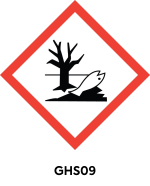
Precautionary statements :
| HAZARD | PRECAUTION |
|---|---|
| H302 Harmful if swallowed.
H411 Toxic to aquatic life with long lasting effects. |
IFRA
IFRA 51th :
This ingredient is restricted by the 51th amendment
-
Restriction type :
RESTRICTION -
Cause of restriction :
DERMAL SENSITIZATION AND SYSTEMIC TOXICITY -
Amendment :
51
Quantitative limit on the use :
| Cat.1 | Cat.2 | Cat.3 | Cat.4 |
Cat.5
A
B
C
D
|
Cat.6 | |||
|---|---|---|---|---|---|---|---|---|
| 0,052 % | 0,027 % | 0,47 % | 0,52 % |
0,13 %
0,13 %
0,13 %
0,043 %
|
||||
|
Cat.5
A
B
C
D
|
Cat.6 | |||||||
|
0,13 %
0,13 %
0,13 %
0,043 %
|
0,052 % | |||||||
|
Cat.7
A
B
|
Cat.8 | Cat.9 |
Cat.10
A
B
|
Cat.11
A
B
|
Cat.12 | |||
|
0,94 %
0,94 %
|
0,043 % | 1,0 % |
2,9 %
3,6 %
|
0,043 %
0,043 %
|
||||
|
Cat.10
A
B
|
Cat.11
A
B
|
Cat.12 | ||||||
|
2,9 %
3,6 %
|
0,043 %
0,043 %
|
No restriction | ||||||
Disclaimer :
ScenTree is solely responsible for the information provided here.
To learn more about IFRA's standards : https://ifrafragrance.org/safe-use/library