














Photo credits: ScenTree SAS
Orivone®
Woody > Dry Woods > Orris Root > Earthy > Nutty
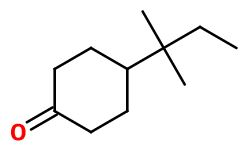
Iris Hexanone ; Orris Hexanone ; 4-(2-methylbutan-2-yl)cyclohexan-1-one ; 4-tert-amyl cyclohexanone ; 4-tert-pentyl cyclohexanone ; 4-(1,1-dimethylpropyl)cyclohexanone ; Orris hexanone


Photo credits: ScenTree SAS
| Company | Ingredient Name | Learn more | Naturality | Certifications | MOQ | Purity |
|---|---|---|---|---|---|---|
|
ORIVONE
ORI-1
|
Discover | - | 10 grs | 92.0 - 100.0 |
ORI-1


General Presentation
-
CAS N° :
16587-71-6 -
EINECS number :
240-642-0 -
FEMA number :
Donnée indisponible. -
FLAVIS number :
Donnée indisponible.
-
JECFA number :
Donnée indisponible. -
Volatility :
Heart -
Price Range :
€€€€
Physico-chemical properties
-
Appearance :
Colorless liquid -
Density :
0,92 -
Refractive Index @20°C :
Donnée indisponible. -
Optical rotation :
Donnée indisponible. -
Vapor pressure :
0,031743 mmHg @23°C -
Flash Point :
104°C (219,2°F)
-
Molecular formula :
C11H20O -
Molecular Weight :
168,28 g/mol -
Log P :
3,4 -
Fusion Point :
Donnée indisponible. -
Boiling Point :
-
Detection Threshold :
Donnée indisponible.
Chemistry & Uses
Uses in perfumery :
Orivone® is used in majority in orris root accords. It can also be used in nutty, dry woods and leather accords, to bring a dry effect and an orris root and powdery note in small quantity.
Year of discovery :
1950
Natural availability :
Orivone® is not found in nature.
Isomerism :
Orivone® is a constitutional isomer of Ethyl Linalool and so called Aldehyde C11 Lenic, but has no common facet with these two molecules.
Synthesis precursor :
Orivone® is not a precursor to the synthesis of any other molecule used in perfumery.
Synthesis route :
Orivone® can be synthesized in one step from 4-tert-amylphenol, by a selective hydrogenation reaction, catalyzed by a heterogeneous catalysor such as palladium on alumina. 4-tert-amylphenol can be taken as a starting reagent, but it can also be synthesized first by an selective alkylation reaction from phenol, on a para position, reacting with amyl chloride, with a Lewis acid catalysor.
Stability :
Stable in perfumes and in diverse functional bases.
Other comments :
Orivone® is one of the key molecule reproducing the smell of orris root.
Labelling
Allergens :
This ingredient does not contain any allergen.
Signal word :
Warning
Hazard pictograms :

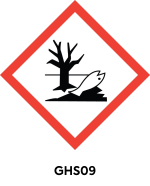
Precautionary statements :
| HAZARD | PRECAUTION |
|---|---|
| H315 Causes skin irritation.
H319 Causes serious eye irritation. H411 Toxic to aquatic life with long lasting effects. |
IFRA
IFRA 51th :
This ingredient is restricted by the 51th amendment
-
Restriction type :
RESTRICTION -
Cause of restriction :
DERMAL SENSITIZATION AND SYSTEMIC TOXICITY -
Amendment :
51
Quantitative limit on the use :
| Cat.1 | Cat.2 | Cat.3 | Cat.4 |
Cat.5
A
B
C
D
|
Cat.6 | |||
|---|---|---|---|---|---|---|---|---|
| 0,027 % | 0,0080 % | 0,16 % | 0,15 % |
0,038 %
0,038 %
0,038 %
0,013 %
|
||||
|
Cat.5
A
B
C
D
|
Cat.6 | |||||||
|
0,038 %
0,038 %
0,038 %
0,013 %
|
0,061 % | |||||||
|
Cat.7
A
B
|
Cat.8 | Cat.9 |
Cat.10
A
B
|
Cat.11
A
B
|
Cat.12 | |||
|
0,24 %
0,24 %
|
0,013 % | 0,29 % |
0,061 %
1,1 %
|
0,013 %
0,013 %
|
||||
|
Cat.10
A
B
|
Cat.11
A
B
|
Cat.12 | ||||||
|
0,061 %
1,1 %
|
0,013 %
0,013 %
|
61 % | ||||||
Disclaimer :
ScenTree is solely responsible for the information provided here.
To learn more about IFRA's standards : https://ifrafragrance.org/safe-use/library