















Photo credits: ScenTree SAS
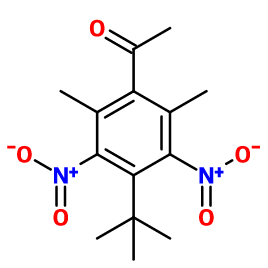
Musk ketone
Musky > Tea
1-(4-tert-butyl-2,6-dimethyl-3,5-dinitrophenyl)ethanone, 1-acetyl-4-(tert-butyl)-2,6-dimethyl-3,5-dinitrobenzene, 4-tert-butyl-2,6-dimethyl-3,5-dinitroacetophenone, 1-(4-tert-butyl-2,6-dimethyl-3,5-dinitrophenyl)ethanone, 4-tert-butyl-3,5-dinitro-2,6-dimethylacetophenone, 1-(4-(1,1-dimethylethyl)-2,6-dimethyl-3,5-dinitrophenyl)ethanone, 1-(4-(1,1-dimethylethyl)-2,6-dimethyl-3,5-dinitrophenyl)-ethanone, ketone moschus, muskketone


Photo credits: ScenTree SAS


General Presentation
-
CAS N° :
81-14-1 -
EINECS number :
201-328-9 -
FEMA number :
Donnée indisponible. -
FLAVIS number :
Donnée indisponible.
-
JECFA number :
Donnée indisponible. -
Volatility :
Base -
Price Range :
€€
Physico-chemical properties
-
Appearance :
Yellow powder -
Density :
1,205 -
Refractive Index @20°C :
Donnée indisponible. -
Optical rotation :
Donnée indisponible. -
Vapor pressure :
Donnée indisponible. -
Flash Point :
100°C (212°F)
-
Molecular formula :
C14H18N2O5 -
Molecular Weight :
294,31 g/mol -
Log P :
Donnée indisponible. -
Fusion Point :
135°C (275°F) -
Boiling Point :
395°C (743°F) -
Detection Threshold :
0,1 ng/l air
Chemistry & Uses
Uses in perfumery :
Musk Ketone is used in women perfumes for a powdery effect. Goes on well with white flowers accords.
Solubilization issues in alcohol.
Mostly used in fine fragrance, less and less beacause of its vintage connotation.
Year of discovery :
Patented in 1893 by Willem Mallmann and transferred to the Laire factories in 1896. The reason? W. Mallmann illegally produced this compound chemically very close to musk Xylene, itself patented by the Fabriques DeLaire in 1888.
Natural availability :
Musk Ketone is not available in its natural state.
Isomerism :
Musk Ketone is a nitrated musk with no isomer used in perfumery.
Synthesis precursor :
Musk Ketone is not a precursor to the synthesis of another compound of olfactory interest.
Synthesis route :
Musk Ketone is synthesized from 1,3-dimethyl-5-tert-butylbenzene, by a Friedel-Craft acetylation, with chloroacetic acid and in the presence of aluminum chloride. This reaction is followed by a nitration of the obtained compound with nitric acid.
Stability :
Musks are very stable, as in alcoholic and in functional fragrances
Other comments :
Musk Ketone is part of the nitrated musk family. Since 1998, it is also the only nitrated musk authorized in perfumery. The others are considered to be toxic and are banned by the IFRA. It is however very probable that the regulatory authorities will prohibit it in the coming years because of the 'precautionary principle'.
It is common to see anosmies on this musk.
Labelling
Allergens :
This ingredient does not contain any allergen.
Signal word :
Warning
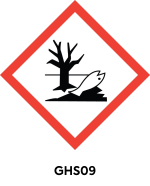
Hazard pictograms :
Precautionary statements :
| HAZARD | PRECAUTION |
|---|---|
| H410 Very toxic to aquatic life with long lasting effects. | P273 Avoid release to the environment.
P391 Collect spillage. P501 Dispose of contents/container to… |
IFRA
IFRA 51th :
This ingredient is restricted by the 51th amendment
-
Restriction type :
SPECIFICATION -
Cause of restriction :
SEE FRAGRANCE INGREDIENT SPECIFICATION -
Amendment :
45
Specified ingredients: notes
Musk xylene (CAS number 81-15-2), which has been prohibited for use in fragrance compounds for environmental reasons (vPvB), can be present in Musk ketone as an impurity.
Musk ketone should only be used if it contains less than 0.1% of Musk xylene.
Disclaimer :
ScenTree is solely responsible for the information provided here.
To learn more about IFRA's standards : https://ifrafragrance.org/safe-use/library