















Photo credits: ScenTree SAS
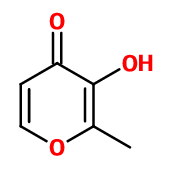
Maltol
Balsamic Ambery > Gourmand > Burnt
3-hydroxy-2-methylpyran-4-one ; Corps praline ; 3-hydroxy-2-methyl-4-pyranone ; 3-hydroxy-2-methylpyrone ; Larixic acid ; Larixinic acid ; 2-methyl pyromeconic acid ; 2-methyl-3-hydroxy-4-pyrone ; 2-methyl-3-hydroxypyrone ; 2-methyl-3-oxidanyl-pyran-4-one ; Palatone ; Talmon ; Veltol ; Vetol


Photo credits: ScenTree SAS


General Presentation
-
CAS N° :
118-71-8 -
EINECS number :
204-271-8 -
FEMA number :
2656 -
FLAVIS number :
7,014
-
JECFA number :
1480 -
Volatility :
Base -
Price Range :
€€
Physico-chemical properties
-
Appearance :
White solid -
Density :
1,35 g/cm³ (masse volumique) -
Refractive Index @20°C :
Donnée indisponible. -
Optical rotation :
Donnée indisponible. -
Vapor pressure :
Donnée indisponible. -
Flash Point :
Donnée indisponible.
-
Molecular formula :
C6H6O3 -
Molecular Weight :
126,11 g/mol -
Log P :
1,16 -
Fusion Point :
162°C (323,6°F) -
Boiling Point :
285°C (545°F) -
Detection Threshold :
35 ppm
Chemistry & Uses
Uses in perfumery :
Maltol is used in gourmet notes. Allows to bring a gourmet effect in woody, floral and fruity notes in particular, then bringing strength, character and sensuality. Often put aside in perfumery for the benefit of Ethyl maltol. Both molecules can also be associated, but with a lower amount of Ethyl maltol, compared to Maltol.
Year of discovery :
Data not available.
Natural availability :
Maltol is present in pine needles (Abies balsamea especially), beech wood and young larval wood (a conifer), from which it can be extracted in its natural state. It is produced by burning the wood and extracting the tar.
Isomerism :
Methyl Furoate is a constitutional isomer of Maltol. They both belong to families of molecules having olfactive similarities : furans and pyrans. Both families have foody and roasted notes.
Synthesis precursor :
Maltol is not a precursor to the synthesis of another compound of olfactory interest.
Synthesis route :
Maltol is a molecule of the pyran family, synthesized from kojic acid, produced naturally by certain species of fungi.
Stability :
Stable in perfumes and diverse functional bases
Other comments :
Maltol is less powerful than Ethyl maltol. Both are often associated in perfumes with a smaller proportion of Ethyl maltol.
Labelling
Allergens :
This ingredient does not contain any allergen.
Signal word :
Warning
Hazard pictograms :
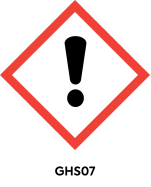
Precautionary statements :
| HAZARD | PRECAUTION |
|---|---|
| H302 Harmful if swallowed. | P264 Wash ... thoroughly after handling. P270 Do no eat, drink or smoke when using this product. P301 + P312 IF SWALLOWED: Call a POISON CENTER/doctor/… if you feel unwell. P315 Get immediate medical advice/attention. P330 Rinse mouth. P501 Dispose of contents/container to… |
IFRA
IFRA 51th :
This ingredient is not restricted for the 51th amendment