












Photo credits: ScenTree SAS
Iso E Super®
Woody > Ambergris > Violet Flower > Cedar
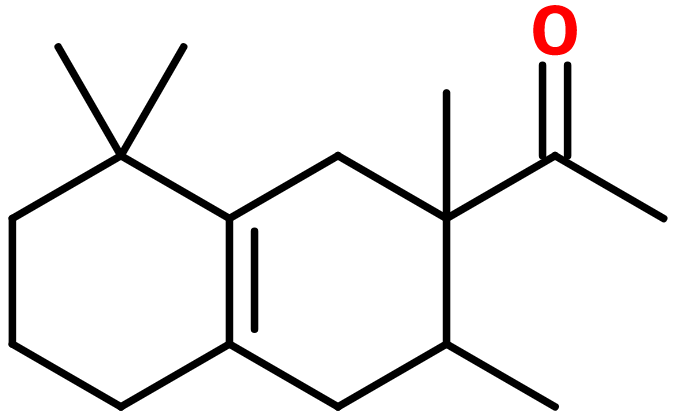
Amberonne® ; Orbitone® ; Arborone® ; 1-(2,3,8,8-tetramethyl-1,3,4,5,6,7-hexahydronaphthalen-2-yl)ethanone ; 1,2,3,4,5,6,7,8-octahydro-2,3,8,8-tetramethyl-2-acetonaphthone ; Amber fleur ; Isoamber super ; Amberfleur ; Ambergris ketone ; Amberix super ; Amberlan ; Ambroise super ; Anthamber ; Boisvelone ; Isocyclemone E ; Dimethyl myrcetone ; Hamber ; Iso gamma super ; Methyl cyclomyrcetone ; Patchouli ethanone ; Sylvamber ; Timbersilk ; Timbrone supra ; Iso velvetone


Photo credits: ScenTree SAS
| Company | Ingredient Name | Learn more | Naturality | Certifications | MOQ | Purity |
|---|---|---|---|---|---|---|

|
ISO MYRCETONE
HAM-1
|
Discover | - | 10 grs | 90 - 100 | |
|
|
ISO MYRCETONE GAMMA
ISG-2
|
Discover | - | 10 grs | 90.0 - 100.0 | |

|
Iso E Super - 30 Gr | Discover | - | 30grs | - | |

|
Iso E Super (Amberix super) | Discover | Synthetic Aroma Chemicals | - | - |
HAM-1

ISG-2

General Presentation
-
CAS N° :
54464-57-2 -
EINECS number :
259-174-3 -
FEMA number :
Donnée indisponible. -
FLAVIS number :
Donnée indisponible.
-
JECFA number :
Donnée indisponible. -
Volatility :
Base -
Price Range :
€€
Physico-chemical properties
-
Appearance :
Colorless liquid -
Density :
0,964 -
Refractive Index @20°C :
1,497 - 1,501 -
Optical rotation :
Donnée indisponible. -
Vapor pressure :
0,0015 mmHg @23°C -
Flash Point :
134°C (273,2°F)
-
Molecular formula :
C16H26O -
Molecular Weight :
234,38 g/mol -
Log P :
5,65 -
Fusion Point :
Donnée indisponible. -
Boiling Point :
290°C (554°F) -
Detection Threshold :
Donnée indisponible.
Chemistry & Uses
Uses in perfumery :
Iso E Super® is used in masculine, woody and ambery notes as a woody base. Allows to bring a light violet flower note to woody accords.
Year of discovery :
Discovered in 1956. Iso E Super® was first patented in 1973, by scientists John B. Hall and James M. Sanders.
Natural availability :
Iso E Super® is not available in its natural state.
Isomerism :
Iso E Super® is composed by more than 20 isomeric molecules. The molecule called Isocyclemone in its pure state, has almost no smell, but the Iso E Super® called " Plus ", so-called Arborone, found at between 2 and 5% in the commercialised Iso E Super®, has a very strong smell (10 000 times more powerful than Iso E Super), and is responsible for the smell of Iso E Super®. Iso E Super® Plus alone is not marketed because its production is too expensive.
Synthesis precursor :
Iso E Super® is not a precursor to the synthesis of another compound of olfactory interest.
Synthesis route :
Iso E Super® is synthesized by a Diels-Alder reaction between Myrcene and 3-methyl-3-penten-2-one in the presence of aluminum chloride. The cyclization of the intermediate product obtained is made thanks to the action of phosphoric acid. This cyclization gives birth to two isomers : Iso E Super® and Arborone, in 95/5 proportions.
Stability :
Stable in perfumes and diverse functional bases
Other comments :
The name of Iso E Super® comes from the contraction of ISOcyclomyrcetone Ethanone, and the SUPERior quality which has been made accessible since the improvement of the manufacturing process. Often called 'bois-violette'.
From 1993, each company was free to produce its own Iso E Super®. The current production of the molecule is 1800 tons per year.
Labelling
Allergens :
This ingredient is classified as an allergen under European Regulation 2023/1545, dated August 26, 2023.
Its presence must therefore be declared on product labels when it exceeds 0.001% in leave-on products and 0.01% in rinse-off products.
Signal word :
Warning
Hazard pictograms :
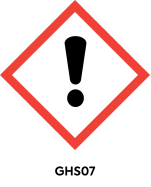
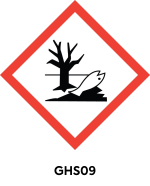
Precautionary statements :
| HAZARD | PRECAUTION |
|---|---|
| H315 Causes skin irritation.
H317 May cause an allergic skin reaction. H410 Very toxic to aquatic life with long lasting effects. |
P261 Avoid breathing dust/fume/gas/mist/vapours/spray. P273 Avoid release to the environment. P280 Wear protective gloves/protective clothing/eye protection/face protection. P333 + P313 If skin irritation or rash occurs: Get medical advice/attention. P391 Collect spillage. P501 Dispose of contents/container to… |
IFRA
IFRA 51th :
This ingredient is restricted by the 51th amendment

-
Restriction type :
RESTRICTION -
Cause of restriction :
DERMAL SENSITIZATION AND SYSTEMIC TOXICITY -
Amendment :
49
Quantitative limit on the use :
| Cat.1 | Cat.2 | Cat.3 | Cat.4 |
Cat.5
A
B
C
D
|
Cat.6 | |||
|---|---|---|---|---|---|---|---|---|
| 0,41 % | 1,1 % | 0,41 % | 20 % |
5,1 %
0,56 %
0,76 %
0,19 %
|
||||
|
Cat.5
A
B
C
D
|
Cat.6 | |||||||
|
5,1 %
0,56 %
0,76 %
0,19 %
|
0,0093 % | |||||||
|
Cat.7
A
B
|
Cat.8 | Cat.9 |
Cat.10
A
B
|
Cat.11
A
B
|
Cat.12 | |||
|
0,67 %
0,67 %
|
0,19 % | 2,4 % |
2,4 %
6,6 %
|
0,19 %
0,19 %
|
||||
|
Cat.10
A
B
|
Cat.11
A
B
|
Cat.12 | ||||||
|
2,4 %
6,6 %
|
0,19 %
0,19 %
|
No Restriction | ||||||
Disclaimer :
ScenTree is solely responsible for the information provided here.
To learn more about IFRA's standards : https://ifrafragrance.org/safe-use/library