










Photo credits: ScenTree SAS
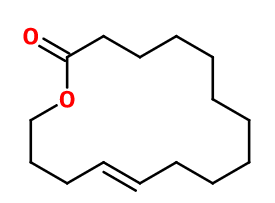
Habanolide®
Musky > Berries > Orange Blossom
(12E)-1-oxacyclohexadec-12-en-2-one


Photo credits: ScenTree SAS
| Company | Ingredient Name | Learn more | Naturality | Certifications | MOQ | Purity |
|---|---|---|---|---|---|---|
|
GLOBALIDE 100% (SYMRISE)
HAB-2
|
Discover | - | 10 grs | - | |

|
HABANOLIDE®
947303
|
Discover | Molecules |

|
- | - |

|
Habanolide® - 30gr | Discover | - | 30grs | - | |

|
Habanolide | Discover | Synthetic Aroma Chemicals | - | - |
HAB-2

947303

General Presentation
-
CAS N° :
111879-80-2 -
EINECS number :
422-320-3 -
FEMA number :
Donnée indisponible. -
FLAVIS number :
Donnée indisponible.
-
JECFA number :
Donnée indisponible. -
Volatility :
Base -
Price Range :
€€€
Physico-chemical properties
-
Appearance :
Colorless liquid -
Density :
0,964 -
Refractive Index @20°C :
Donnée indisponible. -
Optical rotation :
Donnée indisponible. -
Vapor pressure :
0,00003 mmHg @20°C -
Flash Point :
>100°C (>212°F)
-
Molecular formula :
C15H26O2 -
Molecular Weight :
238,37 g/mol -
Log P :
6,2 -
Fusion Point :
-33°C (-27,4°F) -
Boiling Point :
307°C (584,6°F) -
Detection Threshold :
0,5 ng/l air
Chemistry & Uses
Uses in perfumery :
Habanolide® is used in white floral notes, orange blossom and woody notes. Useful in marine and amber notes.
Used only in fine fragrance, especially for colognes.
Year of discovery :
Discovered in 1969. "Habanolide®" tradename has been published and protected by Firmenich SA since 05/03/1992 (brand N°584055)
Natural availability :
Habanolide® is not available in its natural state.
Isomerism :
Two diastereoisomers of Habanolide® exist. The molecule called Habanolide® is the (E) (trans) diastereoisomer of the molecule. The diastereoisomer (Z) is less used, but has a similar smell. The mixture of the two isomers is also widely used.
Synthesis precursor :
Habanolide® is not a precursor to the synthesis of another compound of olfactory interest.
Synthesis route :
Habanolide® is a macrocyclic musk, close to Exaltolide®. Therefore, it can be synthesized in a similar way, by enlarging the Cyclododecenone cycle.
Stability :
Musks are very stable, as in alcoholic and in functional fragrances
Other comments :
In comparision to other musks, Habanolide® has an orange blossom note making the difference with other ones. This facet is only percievable when the molecule macerates a few weeks in its base.
Labelling
Allergens :
This ingredient does not contain any allergen.
Signal word :
Warning
Hazard pictograms :

Precautionary statements :
| HAZARD | PRECAUTION |
|---|---|
| H410 Very toxic to aquatic life with long lasting effects. | P273 Avoid release to the environment.
P391 Collect spillage. |
IFRA
IFRA 51th :
This ingredient is not restricted for the 51th amendment