











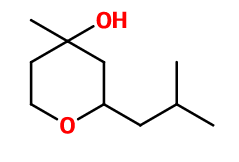
Photo credits: ScenTree SAS
Florol®
Floral > Light Flowers > White Flowers
Florosa® ; 4-methyl-2-(2-methylpropyl)oxan-4-ol ; 2-isobutyl-4-hydroxy-4-methyltetrahydropyran ; Floral pyranol ; Floriffol ; Florosol ; Florotyl ; Flowerol ; Frescoflor ; Keflorol 90 ; Muguetol ; Pyranol ; Tetrahydro-4-methyl-2-(2-methylpropyl)pyran-4-ol


Photo credits: ScenTree SAS
| Company | Ingredient Name | Learn more | Naturality | Certifications | MOQ | Purity |
|---|---|---|---|---|---|---|
|
FLOWEROL 60
FLORA-2
|
Discover | - | 10 grs | - | |

|
FLOROL®
966458
|
Discover | Molecules |

|
- | - |

|
Florol - 30 Gr | Discover | - | 30grs | - | |
|
Pyranol
30221242
|
Discover | Molecule | - | - | |
|
|
Pyranol BMBcert™
30770688
|
Discover | Molecule | - | - | |

|
Florol/Florosa | Discover | Synthetic Aroma Chemicals | - | - |
FLORA-2

966458
30221242
30770688

General Presentation
-
CAS N° :
63500-71-0 -
EINECS number :
405-040-6 -
FEMA number :
Donnée indisponible. -
FLAVIS number :
Donnée indisponible.
-
JECFA number :
Donnée indisponible. -
Volatility :
Heart -
Price Range :
€
Physico-chemical properties
-
Appearance :
Colorless liquid -
Density :
0,952 -
Refractive Index @20°C :
1,455 – 1,460 -
Optical rotation :
Donnée indisponible. -
Vapor pressure :
0,036 mmHg @20°C -
Flash Point :
>100°C (>212°F)
-
Molecular formula :
C10H20O2 -
Molecular Weight :
172,27 g/mol -
Log P :
2,22 -
Fusion Point :
< -100 °C (< -148°F) -
Boiling Point :
227°C (440,6°F) -
Detection Threshold :
Donnée indisponible.
Chemistry & Uses
Uses in perfumery :
Florol® is used to replace Hydroxycitronnellal, for regulatory reasons, for lily of the valley or lilac accords in particular. However, it is less fresh and floral-lily of the valley than Hydroxycitronellal. Also used for its stability.
Year of discovery :
Discovered in 1986. "Florol®" tradename has been published and protected by Firmenich SA since 18/02/1988 (brand N°521114)
Natural availability :
Florol® is not available in its natural state.
Isomerism :
The molecule has an asymmetric carbon, but it is the racemic mixture of Florol® that is used in perfumery. Hydroxycitronellal is a constitutional isomer of Florol®. Moreover, these two molecules are used for the same purpose in perfumery: often for reproductions of lily of the valley notes. In compositions, Florol® tends to replace Hydroxycitronellal as it is not regulated.
Synthesis precursor :
Florol® is not a precursor to the synthesis of another compound of olfactory interest.
Synthesis route :
The synthesis of Florol® is made by cyclocondensation between 3-methyl-3-buten-1-ol and 3-methylbutanal, on silica gel and aluminum oxide, and in the presence of solvent.
Stability :
Unstable in acidic products, except in fabric conditioners, and in alkaline products, except powder detergents.
Other comments :
Unlike Hydroxycitronellal, Florol® is not regulated or allergenic.
Labelling
Allergens :
This ingredient does not contain any allergen.
Signal word :
Warning
Hazard pictograms :

Precautionary statements :
| HAZARD | PRECAUTION |
|---|---|
| H319 Causes serious eye irritation. | P264 Wash ... thoroughly after handling. P280 Wear protective gloves/protective clothing/eye protection/face protection. P305 + P351 + P338 IF IN EYES: Rinse cautiously with water for several minutes. Remove contact lenses, if present and easy to do. Continue rinsing. P337 + P313 If eye irritation persists: Get medical advice/attention. |
IFRA
IFRA 51th :
This ingredient is not restricted for the 51th amendment