















Photo credits: ScenTree SAS
Cashmeran®
Woody > Fresh Woods > Earthy > Camphoric > Musky
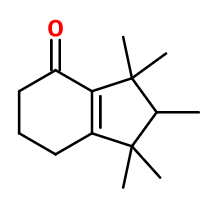
1,1,2,3,3-pentamethyl-2,5,6,7-tetrahydroinden-4-one ; Astromeran ; Cas musc ; Cashmeran velvet ; 6,7- dihydro-1,1,2,3,3-pentamethyl-4(5H)-indanone ; Dihydropentamethyl indanone ; 1,2,3,5,6,7- hexahydro-1,1,2,3,3-pentamethyl-4H-inden-4-one ; Indomuscone ; Ianmeran ; Musk indanone


Photo credits: ScenTree SAS


General Presentation
-
CAS N° :
33704-61-9 -
EINECS number :
251-649-3 -
FEMA number :
Donnée indisponible. -
FLAVIS number :
Donnée indisponible.
-
JECFA number :
Donnée indisponible. -
Volatility :
Heart/Base -
Price Range :
€€€
Physico-chemical properties
-
Appearance :
Colorless liquid that crystallizes at room temperature -
Density :
0,96 -
Refractive Index @20°C :
1,497 - 1,502 -
Optical rotation :
Donnée indisponible. -
Vapor pressure :
0,009 mmHg @23°C -
Flash Point :
94°C (201,2°F)
-
Molecular formula :
C14H22O -
Molecular Weight :
206,32 g/mol -
Log P :
4,5 -
Fusion Point :
27°C (80,6°F) -
Boiling Point :
285°C (545°F) -
Detection Threshold :
1,2 ng/l air
Chemistry & Uses
Uses in perfumery :
Cashmeran® is used in woody, spicy, coniferous and ambery notes. Often associated with Kephalis®, and more generally with woody-ambergris and tobacco notes.
Year of discovery :
Cashmeran® was discovered by scientist John Hall in 1969. At the time, he was working on low cost transformations starting with molecule structures such as pentamethylindane and tetramethylnaphthalène. Patent n°3,773,836 (US) published on Aug.18, 1969 by Hall.J for IFF
Natural availability :
Cashmeran® is not available in its natural state.
Isomerism :
Cashmeran® has an asymmetric carbon. It is nevertheless the racemic mixture of this molecule that is used in perfumery. Alpha-Irone and Isoraldeine® are constitutional isomers of Cashmeran®. However, they have a violet and orris smell, different from Cashmeran®.
Synthesis precursor :
Cashmeran® is not a precursor to the synthesis of another compound of olfactory interest.
Synthesis route :
One of the methods for synthesizing Cashmeran® is to oxidize pentamethyl tetrahydroindene in the presence of a cobalt naphthenate catalyst.
Stability :
Stable in perfumes and diverse functional bases
Other comments :
Cashmeran® has a very singular and complex smell, which differenciates it from any other molecule use din perfumes.
Labelling
Allergens :
This ingredient does not contain any allergen.
Signal word :
Warning
Hazard pictograms :
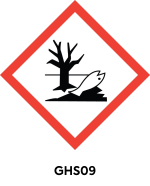
Precautionary statements :
| HAZARD | PRECAUTION |
|---|---|
| H315 Causes skin irritation.
H317 May cause an allergic skin reaction. H319 Causes serious eye irritation. H411 Toxic to aquatic life with long lasting effects. |
P261 Avoid breathing dust/fume/gas/mist/vapours/spray. P273 Avoid release to the environment. P280 Wear protective gloves/protective clothing/eye protection/face protection. P333 + P313 If skin irritation or rash occurs: Get medical advice/attention. P337 + P313 If eye irritation persists: Get medical advice/attention. P362 Take off contaminated clothing. |
IFRA
IFRA 51th :
This ingredient is restricted by the 51th amendment
-
Restriction type :
RESTRICTION -
Cause of restriction :
DERMAL SENSITIZATION AND SYSTEMIC TOXICITY -
Amendment :
49
Quantitative limit on the use :
| Cat.1 | Cat.2 | Cat.3 | Cat.4 |
Cat.5
A
B
C
D
|
Cat.6 | |||
|---|---|---|---|---|---|---|---|---|
| 0,0063 % | 0,26 % | 0,019 % | 3,8 % |
0,31 %
0,025 %
0,038 %
0,0084 %
|
||||
|
Cat.5
A
B
C
D
|
Cat.6 | |||||||
|
0,31 %
0,025 %
0,038 %
0,0084 %
|
0,0063 % | |||||||
|
Cat.7
A
B
|
Cat.8 | Cat.9 |
Cat.10
A
B
|
Cat.11
A
B
|
Cat.12 | |||
|
0,031 %
0,031 %
|
0,0084 % | 0,13 % |
0,13 %
0,28 %
|
0,0084 %
0,0084 %
|
||||
|
Cat.10
A
B
|
Cat.11
A
B
|
Cat.12 | ||||||
|
0,13 %
0,28 %
|
0,0084 %
0,0084 %
|
9,4 % | ||||||
Disclaimer :
ScenTree is solely responsible for the information provided here.
To learn more about IFRA's standards : https://ifrafragrance.org/safe-use/library