













Photo credits: ScenTree SAS
| Company | Ingredient Name | ID | Comments | Naturality | Certifications | MOQ | Purity |
|---|---|---|---|---|---|---|---|

|
BOISAMBRENE FORTE | BAF-1 |
Visit website

|
- | 10 grs | - | |

|
Boisambrene forte - 30 Gr | - |
Visit website
|
- | - | - |


General Presentation
-
CAS N° :
58567-11-6 -
EINECS number :
261-332-1 -
FEMA number :
Donnée indisponible. -
FLAVIS number :
Donnée indisponible.
-
JECFA number :
Donnée indisponible. -
Volatility :
Base -
Price Range :
€€€
Physico-chemical properties
-
Appearance :
Colorless liquid -
Density :
0,931 -
Refractive Index @20°C :
Donnée indisponible. -
Optical rotation :
Donnée indisponible. -
Vapor pressure :
Donnée indisponible. -
Flash Point :
150°C (302°F)
-
Molecular formula :
C15H30O2 -
Molecular Weight :
242,4 g/mol -
Log P :
Donnée indisponible. -
Fusion Point :
Donnée indisponible. -
Boiling Point :
94°C (201,2°F) -
Detection Threshold :
Donnée indisponible.
Chemistry & Uses
Uses in perfumery :
Boisambrene Forte® is used in woody and ambery notes to bring strength and its characteristic note. This compound can also be used in alkaline bases such as soaps or detergents, thanks to its stability.
Year of discovery :
Discovered in 1974.
Natural availability :
Boisambrene Forte® is not available in its natural state.
Isomerism :
Boisambrene Forte® does not have any isomer used in perfumery.
Synthesis precursor :
Boisambrene Forte® is not a precursor to the synthesis of antoher compound of olfactory interest.
Synthesis route :
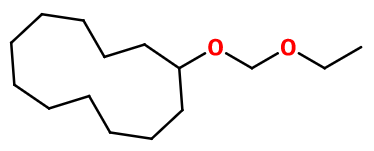
Boisambrene Forte® can be obtained by reaction between cyclododecanol and a gazeous complex of pure paraformaldehyde and hydrochloric acid. The intermediary product is called chloromethoxy cyclododecane. This byproduct can undergo an ethylation reaction with sodium ethanolate, prepared with pure sodium in ethanol.
Stability :
Stable in perfumes and diverse functional bases.
Other comments :
The name Boisambrene Forte® exists as opposed to Boisambrene®, that has a very similar structure (one less carbon atom at the end of the chain) and a slightly different smell.
Labelling
Allergens :
This ingredient does not contain any allergen.
IFRA
IFRA 51th :
This ingredient is restricted by the 51th amendment
-
Restriction type :
RESTRICTION -
Cause of restriction :
DERMAL SENSITIZATION AND SYSTEMIC TOXICITY -
Amendment :
51
- Quantitative limit on the use :
-
Cat.1 Cat.2 Cat.3 Cat.4 Cat.5A B C DCat.6 0,27 % 0,080 % 1,6 % 1,5 % 0,38 % 0,38 % 0,38 % 0,13 %Cat.5A B C DCat.6 0,38 % 0,38 % 0,38 % 0,13 %0,49 % Cat.7A BCat.8 Cat.9 Cat.10A BCat.11A BCat.12 3,1 % 3,1 %0,13 % 2,9 % 11 % 11 %0,13 % 0,13 %Cat.10A BCat.11A BCat.12 11 % 11 %0,13 % 0,13 %No restriction