













Photo credits: ScenTree SAS
Jasmonal H®
Floral > Light Flowers > White Flowers > Anisic > Green Fruits
Hexyl Cinnamaldehyde ; Hexyl Cinnamaldehyde ; 2-(phenylmethylidene)octanal ; 2-benzylidene octanal ; Hexyl cinnamal ; Hexyl cinnamic aldehyde ; 2-hexyl-3-phenyl-2-propenal ; Alpha-N-hexyl-beta-phenyl acrolein ; 2-(phenylmethylidene)octanal


Photo credits: ScenTree SAS
| Company | Ingredient Name | Learn more | Naturality | Certifications | MOQ | Purity |
|---|---|---|---|---|---|---|

|
ALPHA HEXYL CINNAMIC ALDEHYDE
JAHRSPO-1
|
Discover | - | 10 grs | 97 - 100 | |

|
Jasmonal H - 30 Gr | Discover | - | 30grs | - | |

|
Hexyl Cinnamic Aldehyde | Discover | Synthetic Aroma Chemicals | - | - |
JAHRSPO-1


General Presentation
-
CAS N° :
101-86-0 -
EINECS number :
202-983-3 -
FEMA number :
2569 -
FLAVIS number :
5,041
-
JECFA number :
686 -
Volatility :
Heart -
Price Range :
€
Physico-chemical properties
-
Appearance :
Colorless liquid -
Density :
0,955 -
Refractive Index @20°C :
1,548 - 1,552 -
Optical rotation :
Donnée indisponible. -
Vapor pressure :
0,00051 mmHg @25°C -
Flash Point :
151°C (303,8°F)
-
Molecular formula :
C15H20O -
Molecular Weight :
216,32 g/mol -
Log P :
5,3 -
Fusion Point :
18°C (64,4°F) -
Boiling Point :
311°C (591,8°F) -
Detection Threshold :
Donnée indisponible.
Chemistry & Uses
Uses in perfumery :
Jasmonal H® is used in notes of jasmine and lily of the valley, for a waxy facet, close to narcissus, and for trail. Formerly used to replace Hedione®.
Year of discovery :
1930
Natural availability :
Jasmonal H® is found in trace amounts in Roman Chamomile EO and rice. However, it is the synthetic Jasmonal H® that is most often used in perfumery.
Isomerism :
Jasmonal H® has two possible diastereoisomers. However, it is the mixture of the two isomers that is used in perfumery.
Synthesis precursor :
Jasmonal H® is not a precursor to the synthesis of another compound of olfactory interest.
Synthesis route :
As for Jasmonal A®, the synthesis of Jasmonal H® is made by condensation of benzaldehyde with Octanal (Aldehyde C-8), using an excess of benzaldehyde and gradually adding the Aldehyde C-8 in the reaction medium in order to avoid its self-condensation.
Stability :
Aldehydes may form diethylacetals in alcoholic perfumes, with no real impact on their smell.
Jamsonal A colors through time.
Other comments :
Jasmonal A® is more powerful, rising and soapy, but less watery than Jasmonal H®.
Jasmonal H® is one of the 26 allergens in perfumery.
Labelling
Allergens :
This ingredient does not contain any allergen.
Signal word :
Warning
Hazard pictograms :

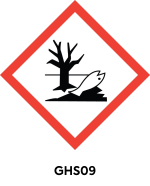
Precautionary statements :
| HAZARD | PRECAUTION |
|---|---|
| H317 May cause an allergic skin reaction.
H400 Very toxic to aquatic life. H411 Toxic to aquatic life with long lasting effects. |
IFRA
IFRA 51th :
This ingredient is restricted by the 51th amendment
-
Restriction type :
RESTRICTION -
Cause of restriction :
DERMAL SENSITIZATION -
Amendment :
49
Quantitative limit on the use :
| Cat.1 | Cat.2 | Cat.3 | Cat.4 |
Cat.5
A
B
C
D
|
Cat.6 | |||
|---|---|---|---|---|---|---|---|---|
| 1,8 % | 0,53 % | 11 % | 9,9 % |
2,5 %
2,5 %
2,5 %
2,5 %
|
||||
|
Cat.5
A
B
C
D
|
Cat.6 | |||||||
|
2,5 %
2,5 %
2,5 %
2,5 %
|
5,8 % | |||||||
|
Cat.7
A
B
|
Cat.8 | Cat.9 |
Cat.10
A
B
|
Cat.11
A
B
|
Cat.12 | |||
|
20 %
20 %
|
1 % | 19 % |
69 %
69 %
|
38 %
38 %
|
||||
|
Cat.10
A
B
|
Cat.11
A
B
|
Cat.12 | ||||||
|
69 %
69 %
|
38 %
38 %
|
No Restriction | ||||||
Disclaimer :
ScenTree is solely responsible for the information provided here.
To learn more about IFRA's standards : https://ifrafragrance.org/safe-use/library