












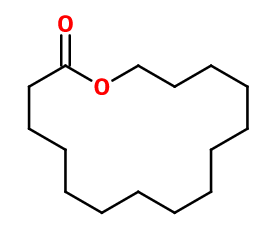
Photo credits: ScenTree SAS
Exaltolide®
Musky > Berries > Violet Flower
Macrolide® ; Exaltex® ; Pentalide® ; 16-oxacyclohexadecan-1-one ; 15-angelica lactone ; Cyclopentadecanolide ; Exaltex ; Hexaltolide ; 15-hydroxypentadecanoic acid lactone ; Muscolactone ; Muskalactone ; Muskolactone ; 2-pentadecalone ; Pentadecan-15-olide ; Pentadecanolid ; Pentalide ; Thibetolide


Photo credits: ScenTree SAS
| Company | Ingredient Name | Learn more | Naturality | Certifications | MOQ | Purity |
|---|---|---|---|---|---|---|
|
PENTADECANOLIDE
PE-1
|
Discover | - | 10 grs | 99% min. | |

|
EXALTOLIDE®
941962
|
Discover | Molecules |

|
- | - |
|
|
EXALTOLIDE® TOTAL
935985
|
Discover | Molecules |
|
- | - |

|
Exaltolide totale - 30 Gr | Discover | - | 30grs | - |
PE-1

941962
935985

General Presentation
-
CAS N° :
106-02-5 -
EINECS number :
203-354-6 -
FEMA number :
2840 -
FLAVIS number :
10,004
-
JECFA number :
239 -
Volatility :
Heart/Base -
Price Range :
€€€
Physico-chemical properties
-
Appearance :
White solid -
Density :
0,918 -
Refractive Index @20°C :
1,4669 @33°C -
Optical rotation :
Donnée indisponible. -
Vapor pressure :
0,0002 mmHg @20°C -
Flash Point :
> 180°C (> 356°F)
-
Molecular formula :
C15H28O2 -
Molecular Weight :
240,39 g/mol -
Log P :
5,79 -
Fusion Point :
36°C (96,8°F) -
Boiling Point :
137°C (278,6°F) -
Detection Threshold :
1 to 4 ppb
Chemistry & Uses
Uses in perfumery :
Exaltolide® is used in red fruits accords such as blackberry, raspberry or blueberry. To be combined with other musks for more facets.
Only used in fine fragrance because of its price. Used in violet flower and leather accords. Prefered in feminine accords for its fruity facets.
Year of discovery :
Discovered in 1926 in ambrette seads. "Exaltolide®" tradename has been published and protected by Firmenich SA since 15/10/1949 (brand N°143584)
Natural availability :
Exaltolide® can be found in trace amounts in Ambrette Seeds Absolute and Angelica Root EO, which allow to extract certain quantities in its natural state.
Isomerism :
Exaltolide® does not have any isomer used in perfumery.
Synthesis precursor :
Exaltolide® is not a precursor to the synthesis of another compound of olfactory interest.
Synthesis route :
The synthesis of Exaltolide® can be done in two major ways. One is to enlarge the cycle size of cyclododecanone. A radical addition of allyl alcohol to this starting reagent, in the presence of a peroxide, allows to implant an alcohol function linked to a carbon chain on the starting molecule. An acidic catalysis enables a dehydration of the intermediate product. Then, an addition of hydrogen peroxide in an acid medium to the molecule obtained in the previous process, followed by a heating of the last intermediate in xylene, allows the synthesis of Exaltolide®. The second synthesis route is made from polyesters of 15-hydroxypentadecanoic acid (which is prepared by a rather complex first process), placed under a high vacuum and in the presence of a trans-esterification catalyst.
Stability :
Musks are very stable, as in alcoholic and in functional fragrances
Other comments :
In comparision to other musks, Exaltolide® has a particularly fruity note and a violet flower undernote.
Labelling
Allergens :
This ingredient does not contain any allergen.
Signal word :
Warning
Hazard pictograms :
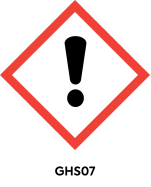
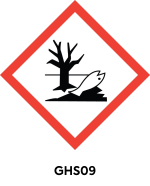
Precautionary statements :
| HAZARD | PRECAUTION |
|---|---|
| H317 May cause an allergic skin reaction.
H411 Toxic to aquatic life with long lasting effects. |
P261 Avoid breathing dust/fume/gas/mist/vapours/spray. P272 Contaminated work clothing should not be allowed out of the workplace. P273 Avoid release to the environment. P302 + P352 IF ON SKIN: Wash with plenty of water/… P333 + P313 If skin irritation or rash occurs: Get medical advice/attention. P391 Collect spillage. |
IFRA
IFRA 51th :
This ingredient is restricted by the 51th amendment
-
Restriction type :
RESTRICTION -
Cause of restriction :
DERMAL SENSITIZATION AND SYSTEMIC TOXICITY -
Amendment :
49
Quantitative limit on the use :
| Cat.1 | Cat.2 | Cat.3 | Cat.4 |
Cat.5
A
B
C
D
|
Cat.6 | |||
|---|---|---|---|---|---|---|---|---|
| 0,42 % | 0,13 % | 2,5 % | 2,4 % |
0,6 %
0,6 %
0,6 %
0,2 %
|
||||
|
Cat.5
A
B
C
D
|
Cat.6 | |||||||
|
0,6 %
0,6 %
0,6 %
0,2 %
|
1,4 % | |||||||
|
Cat.7
A
B
|
Cat.8 | Cat.9 |
Cat.10
A
B
|
Cat.11
A
B
|
Cat.12 | |||
|
4,8 %
4,8 %
|
0,2 % | 4,6 % |
4,6 %
17 %
|
0,2 %
0,2 %
|
||||
|
Cat.10
A
B
|
Cat.11
A
B
|
Cat.12 | ||||||
|
4,6 %
17 %
|
0,2 %
0,2 %
|
No Restriction | ||||||
Annexe I :
Some regulated synthetic ingredients are found in nature and in certain proportions in natural ingredients. This presence in nature has to be taken into account when calculating limits of use recommended by the IFRA. In case you do not know these concentrations, you can use the ones estimated by the IFRA. Here they are :
| List of regulated compounds contained in this ingredient | |||
|---|---|---|---|
| Ingredient Name | Botanical Name | CAS N° | Estimated Concentration |
| Angelica root oil | Angelica archangelica L. | 8015-64-3 | 1,6 |
| Angelica seed oil | Angelica archangelica L. | 8015-64-3 | 0,29 |
| Galbanum oil | Ferula spp. | 8023-91-4 | 0,1 |
Disclaimer :
ScenTree is solely responsible for the information provided here.
To learn more about IFRA's standards : https://ifrafragrance.org/safe-use/library